

What does the overall structure of a diamond drill bit include?
Category: Industry News
Aug 03,2022
Diamond drill bitThe quality of the diamond drill bit and the adaptability of the drill bit type to the lithology of the formation play an important role in accelerating drilling speed and improving single drill bit penetration. Generally, multiple drill bits of different sizes are used to drill a single oil and gas well, with larger diameter bits used for upper formations. Since the formations drilled by the bits are relatively soft, a single bit can achieve more penetration in a shorter time, and one bit can generally be reused in multiple wells; when drilling into lower formations, smaller diameter bits should be used. Due to the hardness of the formation, penetration per bit is smaller, so multiple bits are usually employed. The penetration rate of new bits in wells mainly depends on the size and type of the bit, formation hardness, and coordination of drilling parameters. In general, the smaller the bit size, the harder the formation and the smaller the penetration; conversely, larger bit sizes correspond to softer formations and greater penetration. Below is an introduction to the overall structure of diamond drill bits:
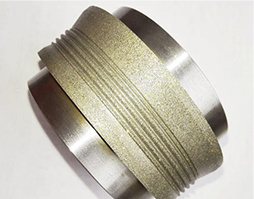
Diamond drill bitIt is a solid drill bit with no moving parts throughout. It mainly consists of five parts: drill body, crown, hydraulic structure (including water holes or nozzles, water tank also known as flow channel or chip removal groove), diameter maintenance part and cutting edges (teeth).
1. The crown of a diamond drill bit is its working part that cuts through rock. Its surface (working face) is embedded with diamond material cutting teeth and has hydraulic structures. Its sides serve as diameter maintenance components (embedded with diameter maintenance teeth) connected to the drill body made from tungsten carbide matrix or steel.
2. The drill body is made of steel; its upper part connects to the drill string via threads while its lower part connects to the crown matrix (the steel crown is integrated with the drill body).
3. The hydraulic structure of diamond drill bits can be divided into two categories. One type is for natural diamond bits. In this type, drilling fluid flows out from a central water hole and diffuses through water tanks on the surface of the bit to all parts of its working face for cooling, cleaning, and lubricating cutting teeth before transporting rock cuttings from side water tanks and chip removal grooves into annular space.
4. The diameter maintenance part made from diamond material helps stabilize the position of the drill bit ensuring that during drilling operations there will be no reduction in borehole diameter. This is achieved by embedding diamonds along its sides.
Diamond drill bitThe materials for cutting teeth are divided into natural diamonds and synthetic diamonds. Diamond is a carbon crystal with a tetrahedral crystal structure where carbon atoms are connected by covalent bonds making it very stable structurally. Typical shapes include cubes, octahedrons, and dodecahedrons.
Diamond is currently one of the hardest materials known to humanity with high compressive strength and excellent wear resistance making it an ideal material for cutting edges on drills. Diamond tools are widely used in geological exploration, stone processing, machinery manufacturing, automotive industry, defense industry among others. The manufacturing technology level for grinding tools used in machining processes as well as geological drills and stone saws has significantly improved.
Related Articles
Aug 16,2021
Mar 18,2022
Aug 16,2021
Aug 16,2021
Aug 27,2021
Aug 27,2021


Tel:
E-mail:
Address:
Southwest corner of intersection of Zhongshan Road and Longjiang Road, Urban-rural Integration Demonstration Zone, Luohe City, Henan Province
HUATAO GROUP
Leave a message immediately.
Expand your business with a trusted partner