

Reasonable use of diamond drill bits for mining

Feb 16,2022

How to use a good composite diamond drill bit is the key to achieving drilling results. In actual production, due to improper usage, drill bits often wear out prematurely. To ensure the normal use of diamond drill bits, it is necessary to strictly follow the requirements below:

  How to use good compositesDiamond drill bitis the key to achieving drilling results. In actual production, due to improper usage, drill bits often become prematurely unusable. To ensure the normal use of diamond drill bits, strict adherence to the following requirements is necessary:


  1) A reasonable grade of diamond drill bit should be selected, ensuring stable operation and avoiding damage to cutting teeth due to unbalanced forces.


  2) The impact resistance of diamond drill bit cutting teeth is weak; they should be gently placed during transportation and handling. It is strictly prohibited to drill, hit, bump, or throw. Drill bits should be stored in a dry and well-ventilated environment.


  3) To take out the diamond drill bit from the box, soft materials should first be used for padding. Avoid contact with steel or other hard materials or rolling the drill bit to prevent damage to cutting teeth and screws.


  4) Before using the diamond drill bit, a site inspection of all parts must be conducted. This includes checking if the drilling diameter meets requirements, if connection threads are damaged, if cutting teeth are damaged, if there are foreign objects in the hole, and if the water tank is unobstructed.
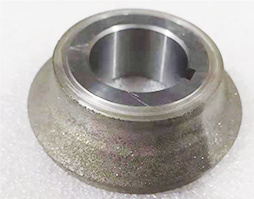
       Diamond drill bit

  5) When installing and removing diamond drill bits, a hammer should be used to tap on the drill bit to avoid damaging cutting teeth or diameter areas. Lubricating grease should be applied on threaded parts before installation.


  6) Before drilling and during drilling, ensure that the drilling point is adjusted into a pit shape to prevent excessive movement of the drill bit that could cause damage. During drilling or after secondary drilling, light pressure should first be used with slow rotation and appropriate pump volume at depths of 0.2 ~ 0.3 meters; after completing the bottom shape of the hole, gradually increase the drill speed and pump volume evenly before proceeding with normal drilling procedures.


  7) The descent speed must be slow to prevent rock probes or falling rocks from impacting the drill bit and cutting teeth. Before approaching the bottom of the hole with a diamond drill bit, turn on the pump for thorough flushing at the bottom while observing whether water flow is normal to prevent clogging of water holes in the drill bit.


  8) Ensure that the bottom of the hole is clean during drilling; foreign objects such as fallen cutting teeth, hard alloys, or steel inside can lead to premature damage of directional drills.


  9) Composite boards and diamond drill bits are welded with low-temperature solder; therefore, working drills must have sufficient circulating cleaning fluid for cooling and cleaning purposes. Water supply must not be interrupted during drilling operations to avoid accidents while preventing debris from repeatedly breaking down which affects tool life.


  10) Drilling operations must be conducted cautiously; any abnormal vibrations or lack of particles along with significant increases or decreases in pump pressure or sudden drops in mechanical drilling speed or increases in torque must prompt immediate investigation; if necessary, inspection drills should be performed without applying pressure.


  11) When directional drills encounter highly abrasive intermediate layers, wear on cutting teeth will intensify with increased rotation speed and drilling pressure. To extend diamond drill life, low-speed drills should be used whenever possible. In cases of geological changes or interlayers occurring for optimal hole life and speed performance adjustments in pressure and rotation speed must occur promptly.


  12) Normal drilling should adhere to constraints based on product conditions involving both pressure and rotation speed; operations during drilling must proceed smoothly without abrupt lifting actions like heavy lifting or re-drilling.


  13) Avoid using a drill head for enlarging holes whenever possible; if short sections require holes then small pressures combined with appropriate speeds along with high pump volumes should suffice.


  14) In later stages of using diamond drills due to wear on cutting teeth increasing surface area under pressure necessitates an increase in drilling pressure accordingly maintaining consistent speeds throughout operations.


  15) When using multiple heads on one same tool they need alternating usage starting from larger outer diameters followed by smaller ones subsequently.


  Diamond drill bit有时会出现泥浆包装现象,影响正常钻孔,主要迹象是钻头速度和扭矩突然下降,泵压增加,此时清洗钻头是主要方法。就是将钻头从孔底抬起,然后打开较大的泵量和正常转速,清理钻头表面。


Related Articles

Using diamond grinding wheels to dress the grinding wheel, the profile is opposite to the required wheel profile, and it moves in the same direction as the wheel being dressed, shaping the wheel into the desired form. The dedicated grinding machine for lock clamps uses diamond wheels to dress the grinding wheel, which is then used to grind valves. The diamond wheels we use are coated with a layer of uniformly distributed diamond particles on a steel substrate through electroplating. When using them, two points must be noted: First, when loading and unloading the diamond wheel, gently tap with a copper rod to prevent diamond particles from falling off. Second, before dressing the grinding wheel with the diamond wheel, it is essential to adjust the relative position of the diamond wheel and grinding wheel in manual mode. For example: The automatic compensation amount for J4-048 lock clamp grinder is 0.01mm with a compensation amount of 50mm. To meet this compensation amount, a grinding wheel grit size of 120# is generally selected. When grinding lock clamp grooves, we dress the grinding wheel once every 20 products, taking 30 seconds for dressing time and maintaining a dressing line speed ratio of 0.59. Sampling tests show that surface roughness Ra is between 0.63 and 1.25μm, and shape and positional accuracy are within 0.03mm, fully meeting customer requirements. Practice has proven that one diamond wheel can produce 60,000 to 80,000 qualified products. The precision of lock clamp grooves mainly relies on the accuracy of the diamond wheels. As a core component of lock clamp groove grinders, the design of its profile is particularly important. Using diamond wheels produced by Dongjin in Henan for dressing grinding wheels ensures high precision and long service life while achieving good surface roughness in workpiece processing, making it especially suitable for mass production.

Mar 18,2022


Researchers in Australia have made breakthrough progress using the power of diamonds, potentially revolutionizing the way the human body accepts biomedical implants. Researchers from RMIT University successfully coated 3D printed titanium implants with diamonds. This is the use of 3D printed diamond implants for biomedical and orthopedic applications, involving surgeries related to the human musculoskeletal system. Although titanium provides a fast, accurate, and reliable material for medical-grade and patient-specific implants, our bodies sometimes reject this material due to compounds on titanium that prevent effective interaction between tissues and bones with biomedical implants. Synthetic diamonds offer a cost-effective solution to this problem. This breakthrough was achieved by biomedical engineer Dr. Kate Fox and her team at RMIT's School of Engineering. The coating was produced using a microwave plasma process at the Melbourne Nano Manufacturing Centre. The combination of titanium scaffolds with diamonds forms a biomaterial. "This technology will take several more years to launch; many steps need to be taken before it can be used by patients," Fox said. "But what we have done is a key step in a long and incredible journey." Postdoctoral researcher Aaqil Rifai is collaborating with Fox on this new technology research, stating, "Diamonds are very effective because carbon is a major component of the human body. Carbon has incredible biocompatibility." Rifai added, "Our bodies easily accept diamonds and use them as platforms for complex material interfaces." In addition to orthopedics, diamonds are also used to coat cardiovascular stents—catheters that help keep heart arteries open—as well as in bionics and prosthetics. Currently, researchers are focusing on how to apply this technology in orthopedics. "3D printing is a groundbreaking revolution in modern times. Through 3D printing, we can design specific medical-grade implants. This technology is fast, accurate, reliable, and labor-saving," Rifai said: "The scalability of 3D printing is rapidly increasing; therefore, we can foresee that diamond coatings will become increasingly common in orthopedics in the near future." Diamonds are one of the special materials found in nature with properties such as hardness, low friction coefficient, high elastic modulus, high thermal conductivity, high insulation properties, wide bandgap, high sound propagation rate, and good chemical stability. Although natural diamonds possess these characteristics, they have only existed as gemstones; their variability and rarity greatly limit their applications. However, CVD diamond films prepared by Luoyang Yuxin Diamond combine these excellent physicochemical properties at a lower cost than natural diamonds and can be fabricated into various geometric shapes with broad application prospects in industries such as electronics, optics, and mechanics.

Aug 16,2021


In June 2020, China's foreign exchange for bearing imports was $368 million, an increase of 10.13% month-on-month and a year-on-year increase of 34.64% compared to June last year, with an increase of 26.47 percentage points from the previous month's growth rate of 8.17%. The number of bearing imports reached 191 million sets, a month-on-month increase of 3.74%, a year-on-year increase of 26.61% compared to June last year, and an increase of 22.61 percentage points from the previous month's growth rate of 4%. As of June 2020, China had accumulated foreign exchange for imports totaling $1.907 billion, which is a year-on-year increase of 12.37%. This is an increase of 4.27 percentage points from last month's rate of 8.1%. The number of imported bearings was 1.151 billion sets, an increase of 15.31% compared to the same period last year, and an increase of 2.02 percentage points from last month's growth rate of 13.29%. From the perspective of imported bearing categories, the foreign exchange for tapered roller bearings increased by 45.98% year-on-year, becoming the main driver for bearing import foreign exchange; followed by bearing parts with a year-on-year growth rate of 25.3%, other ball bearings with a growth rate of 23.24%, cylindrical roller bearings with a growth rate of 15.39%, and spherical roller bearings with a growth rate of 13.73%. It is not difficult to see that under the new situation, significant changes are occurring in the structure of the bearing market. From the perspective of importing countries, foreign exchange from Japan reached $490 million, ranking first with a year-on-year growth rate of 4.61%. Germany ranked second with $420 million in foreign exchange for imports but had a remarkable growth rate of 28.31%. Surprisingly, Taiwan's import foreign exchange for bearings reached $137 million, ranking third with an astonishing year-on-year growth rate of 346%. This indicates that as China's economic structure adjusts, significant changes are also occurring in the market for importing countries for bearings.

Aug 27,2021


Get A Quote

We always uphold the business philosophy of win-win cooperation, look forward to working with you hand in hand, mutual benefit and win-win, create brilliant!

Submit Message

* Note: Please be sure to fill in the information accurately and keep the communication unblocked. We will get in touch with you as soon as possible.